The talks are following up the outcome of the 19th round of Corps Commander-level talks held between the two sides on August 13-14 at the Chushul Moldo border meeting point.
The last time the Chinese military had taken Indian soldiers captive was in July 1962 after a clash in Galwan Valley.

Chinese foreign ministry spokesman Geng Shuang told a media briefing in Beijing that "at the moment the situation in the boundary region between China and India is overall stable and controllable".

The last conversation between the two leaders was on April 4 on the issue of hydroxychloroquine.

In the review meeting, Singh told the top military brass to continue to deal with the situation in eastern Ladakh and other areas with "firmness".

The talks came a day after the two armies began a limited disengagement in a few areas in Galwan Valley and Hot Spring in a demonstration of their intent to end the row peacefully.

With the two armies again in a face-off at multiple points, there is apprehension of renewed clashes.

The memorial has been built at the unit level near the KM-120 post on the strategic road Durbuk-Shyok-Daulat Beg Oldie, Ladakh. The memorial has names of 20 soldiers and the details of the June 15 operation.

In underlining the role of border villages as custodians of India's frontiers, New Delhi is following China's example in Tibet.
China and India have agreed to work to maintain peace along the Line of Actual Control and resolve the border standoff through talks while implementing the consensus reached between the two countries' leadership that 'differences' do not escalate into 'disputes', a top Chinese official said.
The Indian side is expected to present specific proposals at the talks to deescalate tension in Pangong Tso, Galwan Valley and Demchok -- the three areas in eastern Ladakh where the two sides have been on a bitter standoff for last one month, the sources said.

Defence Minister Rajnath Singh on Saturday asserted that the government will not allow India's pride to be hurt under any circumstances even as he said bilateral talks were on at military and diplomatic levels to resolve the row.
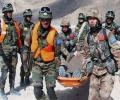
This is the first such incident along the border with China that Indian armed forces personnel have been killed after a gap of nearly 45 years.

Lack of infrastructure development in Jammu and Kashmir for decades post Independence was one of the reasons behind the rise of terrorism in the Union territory, Defence Minister Rajnath Singh said on Friday after unveiling 75 new projects including bridges, roads and helipads in border areas.
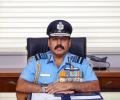
Air Chief Marshal Bhadauria was at the Leh IAF base on Wednesday where he reviewed operational preparedness of the force in effectively guarding the sensitive border areas in eastern Ladakh where Indian and Chinese armies have been on a nearly six-week standoff.
Within the army, there is growing concern that New Delhi will allow the Chinese to retain the territory they have occupied in the last month.

Sources said the Indian delegation was warmly greeted by senior officials of the Chinese Army before the talks began.
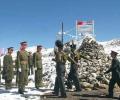
The two sides have already held at least 12 rounds of talks between local commanders and three rounds of talks between major general-rank officials but no positive outcome came out from the discussions, they said.
The enhancement of combat capability by the two armies in the region came even as both the countries continued their efforts to resolve the dispute through talks at military and diplomatic levels.

The chief was also briefed extensively about the air maintenance operations in support of the Indian Army and the paramilitary troops there.
Twenty Chinese soldiers, who had last week entered Indian territory near the Line of Actual Control and pitched their tents in the Chepzi area in Ladakh, have returned after a flag meeting between the two sides, sources said on Monday.
Responding to Conservative Party MP Flick Drummond on the implications for British interests of a dispute between a 'Commonwealth member and the world's largest democracy on the one side, and a state that challenges our notion of democracy on the other,' he described the escalation in eastern Ladakh as "a very serious and worrying situation", which the UK is "monitoring closely".

Monday's clash was the biggest confrontation between the two militaries after their 1967 clashes in Nathu La when India lost around 80 soldiers while over 300 Chinese Army personnel were killed in the confrontation.

Until last month more than two-thirds of the Indian Army was deployed against Pakistan. Of 14 army corps, just four-and-a-half faced China, while more than twice that number was ranged against Pakistan.
It is learnt that Defence Minister Rajnath Singh has conveyed to top military brass that there was no need for reviewing the implementation of any of the key projects along the Line of Actual Control (LAC) in Ladakh, Sikkim, Uttarakhand or in Arunachal Pradesh in view of the aggressive behaviour by Chinese troops in several sensitive areas.
Indian military sources said no firearms were used in the clashes and that most of the injuries were sustained following stone-pelting and use of rods by the Chinese side.

A committee tasked by Prime Minister Manmohan Singh to assess the situation on the China border is understood to have reported that Indian troops are not being allowed to patrol up to the perceived Line of Actual Control by Chinese army.

The T-72 tank with five soldiers on board sank due to flash floods while they were crossing the river.

The Indian delegation, comprising several officers and soldiers of the army, attended the celebration following an invitation by the PLA.
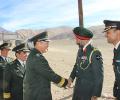
Amidst reports of Chinese incursions, the Peoples Liberation Army and the Indian Army on Sunday decided to uphold treaties and agreements signed between the governments of the two sides to maintain peace and tranquility along the Line of Actual Control.

The armed forces are seeking an enhancement of allowances for their personnel posted in "hardship" areas on the pattern of high-altitude Siachen in Jammu and Kashmir.

India on Wednesday delivered a strong message to China that the 'unprecedented' incident in the Galwan Valley will have a 'serious impact' on the bilateral relationship and held the 'pre-meditated' action by Chinese army directly responsible for the violence that left 20 Indian Army personnel dead.
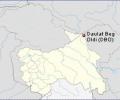
With the Indian Air Force now able to operate C-130 Hercules transport aircraft at high-altitude Daulat Beg Oldie sector in Ladakh, China is reported to have built a radar station on its side of the border ostensibly to monitor movement of Indian planes over the area.

The forward airbase near the PoK-China border, which from where Pakistan is around 50 kilometres and the strategic Daulat Beg Oldi is around 80 kilometres, the activity of fighter, transport aircraft and helicopters is going on during both day and night.

The incident occurred on March 8 when a platoon of at least 11 PLA men led by a colonel-rank officer crossed over the imaginary LAC.

DoT is even considering measures to urge private telecom operators to bring down their dependence on Chinese-made telecom equipment.
Asked about the reports of the troops on both sides disengaging and moving back to their previous positions, Chinese foreign ministry spokesperson Hua Chunying told a media briefing in Beijing that both sides are taking steps to ease the situation along the borders.

The capability of operating fighter aircraft from this area would strengthen the air force's ability to tackle any misadventures by the adversary in a faster way.
The Indian delegation led by Lt General Harinder Singh, the general officer commanding of Leh-based 14 Corps, and Commander of the Tibet Military District Maj Gen Liu Lin held an extensive meeting in Maldo on the Chinese side of the Line of Actual Control in eastern Ladakh on Saturday that began at around 11.30 am and went on till evening.

Pliot error is understood to have been found as the reason behind the crash of Indian Air Force's C-130J Super Hercules aircraft in March in which five service personnel, including four officers, were killed near Gwalior.
